Stan VanderWerf Candidate for Colorado Springs Mayor
Colorado Springs mayoral candidate Stan VanderWerf addressed the Republican Strategy Forum on September 30, 2026, laying out a sharp critique of current Mayor Yemi Mobolade and detailing his own vision for the city. VanderWerf, who announced his candidacy on June 2, 2026, with a kickoff event the end of September, positioned himself as a conservative ready to restore accountability, fiscal discipline, and limited government.
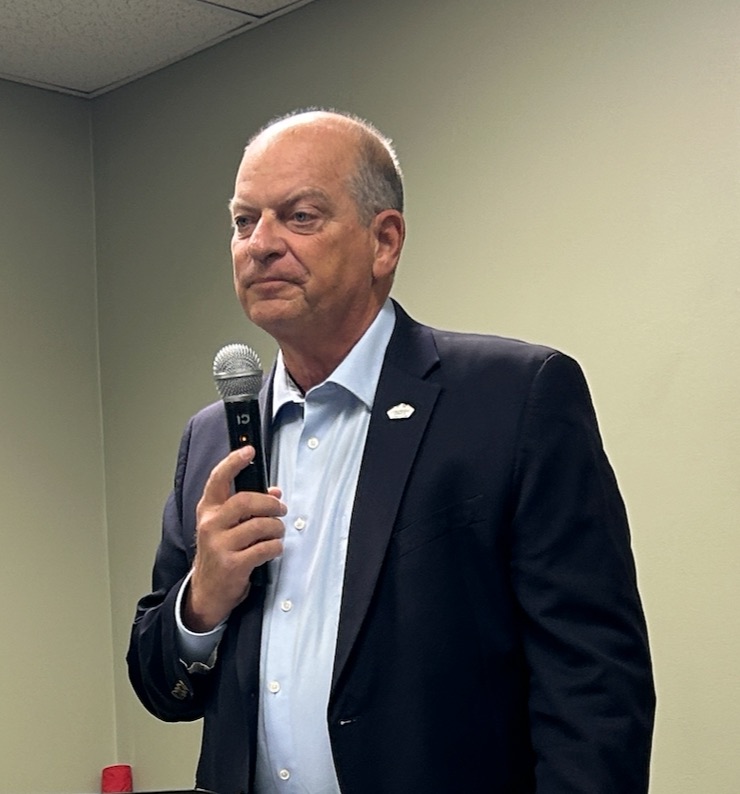
A retired Air Force Colonel with 28 years of service, VanderWerf’s background is an Industrial Engineer trained to analyze and improve processes. He ran the C-130 program office during 9/11, ensuring nearly the entire fleet remained operational. He later served eight years as a County Commissioner through the COVID period and currently represents CD5 on the State Board of Health, where he has frequently been the lone dissenting vote on issues such as grant funding for needle exchange programs.
VanderWerf accused Mayor Mobolade of incompetence and ethical lapses. He claimed the mayor “has no idea what he is doing,” that the city is “drifting,” and that Mobolade fails to distinguish between ethical and unethical conduct. VanderWerf specifically cited Mobolade taking a city vehicle to Crested Butte with his family for skiing. He noted that under former Mayor John Suthers the city routinely ranked in the top 10 nationally, but has since fallen into the 400s.
The candidate highlighted a projected $30–40 million budget shortfall for 2026 caused by poor financial planning. This has led to employee furloughs, the closure of a community center, and cuts across multiple departments. Firefighters lost their clothing allowance entirely as a result. VanderWerf also pointed to ongoing friction between the mayor and City Council, describing Mobolade as indecisive and unwilling to build relationships.
On the proposed data center, VanderWerf said the contract was never properly negotiated in advance. He noted the mayor skipped a contentious community meeting where four citizens were arrested, including one for assaulting a police officer, despite knowing the event would be volatile.
VanderWerf’s platform centers on limited government, private-sector solutions, and measurable outcomes. He stated the best way to solve community problems is to let the community handle them rather than expanding government. He emphasized delivering safe and efficient public services such as road maintenance and park upkeep, while arguing that the city’s 5,000 nonprofits can often stretch dollars further than bureaucracy. He pledged to speak publicly about a “private action model” that reduces government burdens and focuses on results.
VanderWerf criticized the current mayor’s broken promise of increased citizen engagement, claiming past city employees report that Mobolade listens only to a small inner circle. His own vision is to make Colorado Springs “the greatest city in the nation” by recovering from the losses of the last three years, rebuilding relationships with elected officials, and improving direct engagement with residents.
On land-use issues, VanderWerf condemned the handling of a mosque application submitted in April 2024. Neighbors only learned of it through a Gazette article in January 2026. He described the process as an under-the-table administrative review that bypassed public scrutiny. VanderWerf stated that Islam is not merely a religion but a system that believes in a different law than U.S. law, and that its adherents cannot assimilate. He opposed expanding administrative approvals for controversial projects and called for stronger citizen input. He also criticized “flagpole” annexations that allow development of land miles outside current city limits and warned against granting excessive waivers to developers on water rights and other requirements.
Regarding the temporary 2C sales tax intended to fix potholes, VanderWerf said the program has failed to deliver. The city’s Pavement Condition Index remains at 60 while the county improved to 70 after investing more effectively. He noted that 20 percent of 2C funds go to overhead and that the city is replacing concrete unnecessarily. VanderWerf proposed cutting overhead to 10 percent, avoiding replacement of good handicap ramps, and reducing concrete costs, which he estimates would free another $14 million for pavement work. This could raise the city’s PCI to 70 percent and potentially allow the tax to be reduced or ended. Improved roads equate to citizens saving an estimated $150 million annually in vehicle repair costs.
VanderWerf listed his top priorities as public safety, infrastructure, cost of living, and reducing government burdens. He described unfunded mandates from the state legislature as a major problem and stated that COVID policies were managed incorrectly at the state and county level.
VanderWerf described himself as a lifelong conservative whose Kennedy Democrat parents would be appalled by the current direction of the Democratic Party. He closed by stressing the need to set a clear vision, inspire residents behind it, and return the city to a model of limited government focused on private initiative and tangible results.